
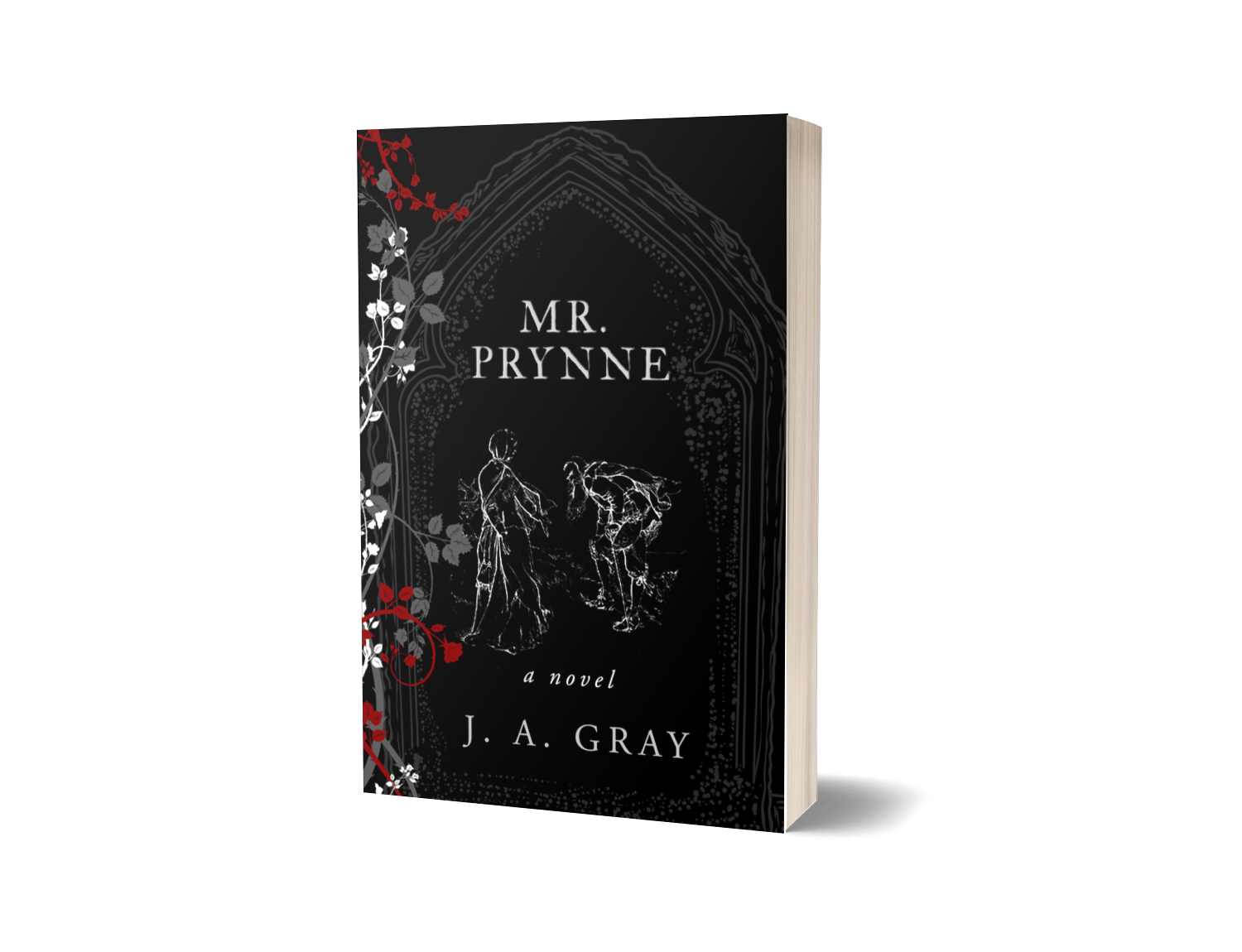
Who Is Mr. Prynne?
Millions of people have read The Scarlet Letter, but not one of them knows the full story of Hester Prynne, her priestly lover, her physician husband, and her talented daughter. And why? Because before now the full story had never been written. After 175 years, an admirer of Nathaniel Hawthorne’s work has followed in his footsteps and has created the tale of Mr. Prynne.
October 27, 2026 publication at Wiseblood Books.

About This Novel
Since Nathaniel Hawthorne’s book The Scarlet Letter: A Romance was published in 1850, millions of readers have been swept into Hester Prynne’s story of sin, solitude, penance, and punishment. Now, in a novel entitled Mr. Prynne, J. A. Gray re-tells this old tale from a new perspective—that of Hester’s long-lost husband.
Readers of The Scarlet Letter will remember the opening scene: Prynne arrives at long last in Puritan Boston, and the first thing he sees is a jeering crowd gathered before a platform where his beautiful young wife, Hester, is on display as a convicted adulteress—with a baby in her arms and a large red A pinned to her bosom. When some busybody asks the stranger who he might be, Prynne adopts the pseudonym of Roger Chillingworth, and begins his secret search for the man who has so used his wife—and has abandoned both Hester and her baby.
Shortly before The Scarlet Letter: A Romance was released to the public, Hawthorne warned his publisher that the story was “dark and dismal.” And so it is. He set his fiction in 1642, in the Massachusetts Bay Colony, in a new little town named Boston, a sternly Christian community which Hawthorne the artist portrayed as troubled by sin and guilt and secrets. Hawthorne warns us, on the first page of his book, that what he offers is “a tale of human frailty and sorrow.”
But in the embryonic city of Boston there are human strivings that are neither dark nor dismal: There is love and loyalty and insight; there is responsibility and child-rearing; there is charity; and there is healing. How did Hawthorne in his writing overlook all this? And how did Roger Chillingworth come to be considered one of the prime villains of our national literature? What are the truths about him, his wife, her lover, and her daughter, that we can learn from Mr. Prynne?
Nathaniel Hawthorne in 1851 wrote a brief essay in which he sharply distinguishes a “Romance” from a “Novel.” To write a Novel (he declared) is “to aim at a very minute fidelity . . . to the probable and ordinary course of man’s experience.” To write a Romance, however, is “to present the truth [of the human heart] under circumstances . . . of the writer’s own choosing or creation.” Clearly, The Scarlet Letter: A Romance was properly labeled by its author in 1850, and it wears its subtitle well.
In 2026, however, Mr. Prynne is a fully fleshed-out work of fiction and carries no subtitle. It is unmistakably a Novel, a fresh and deep exploration of the challenges and struggles and achievements, the loves and losses and learnings, of our fictive Bostonians, in “the probable and ordinary course” of their complicated lives.
In this novel, the Bostonians of 1642 come to life again, new characters join them, new scenes unroll, unexpected challenges appear, fresh insights are gained, and things never before imagined are revealed.
Praise for Mr. Prynne
Free Downloads for Readers
-
Print A Flyer, <br> Tell A Friend
FOR READERS WHO WANT / TO SPREAD THE WORD
J. A. Gray invites readers to Massachusetts in 1642 and to the little Puritan town of Boston. See characters we’ve known for 175 years—Hester, Pearl, Arthur, and Chillingworth—take on new life and share more about themselves than ever before. Click here for a flyer, to print and to share widely. -
Scarlet Litter: An Exculpatory Essay
FOR READERS WHO WANT THE INSIDE STORY
Nathaniel Hawthorne in 1850 found in a dusty storeroom some old writing about Hester Prynne, and was inspired to develop it into The Scarlet Letter. Many decades later, J. A. Gray read Hawthorne’s book, admired it, and was inspired to develop it into the novel Mr. Prynne. Inspired how? By Nathaniel himself. -
Scarlet Letter <br> Borrowings
FOR REVIEWERS, SCHOLARS, CRITICS, AND BOOKWORMS
This PDF allows a curious reader of the new novel Mr. Prynne to see which words in it have been written by J. A. Gray and which have been borrowed from Nathaniel Hawthorne. Here you can browse the full text of Hawthorne’s pair of 1850 publications: “The Custom-House” and The Scarlet Letter: A Romance.